
Play the long game.
Cutting carbs has more evidence behind it for lowering blood glucose than any other change to what you eat. It also changes how much medication you need, sometimes within days. The Long Game is a 14-day keto plan built to be used with your doctor: the questions to ask first, steak and salmon for dinner, total and net carbs on every plate, and a log to take back.
$19one payment, instant download
Get the playbook — $19Or start free with the Doctor’s Brief
- 77-page PDF. Works on a phone and prints cleanly.
- 14-day satisfaction guarantee.
- For type 2 diabetes. Talk to your prescriber before you start. Here is why.

The leaflet. The lecture. The list of things you can no longer have.
About 40 million Americans have diabetes, according to the CDC. A lot of the food advice men are given comes down to eating less of everything they like.
The plate
Dinner has become the thing you are doing wrong, three times a day, with a smaller portion of it as the reward.
The numbers
Your A1C comes back every few months like a school report, and nobody has shown you which part of your day moves it.
The internet
Half of it promises a cure. The other half says keto is dangerous. Both leave out the part that matters: your medication.
This starts in your doctor’s office, not your kitchen.
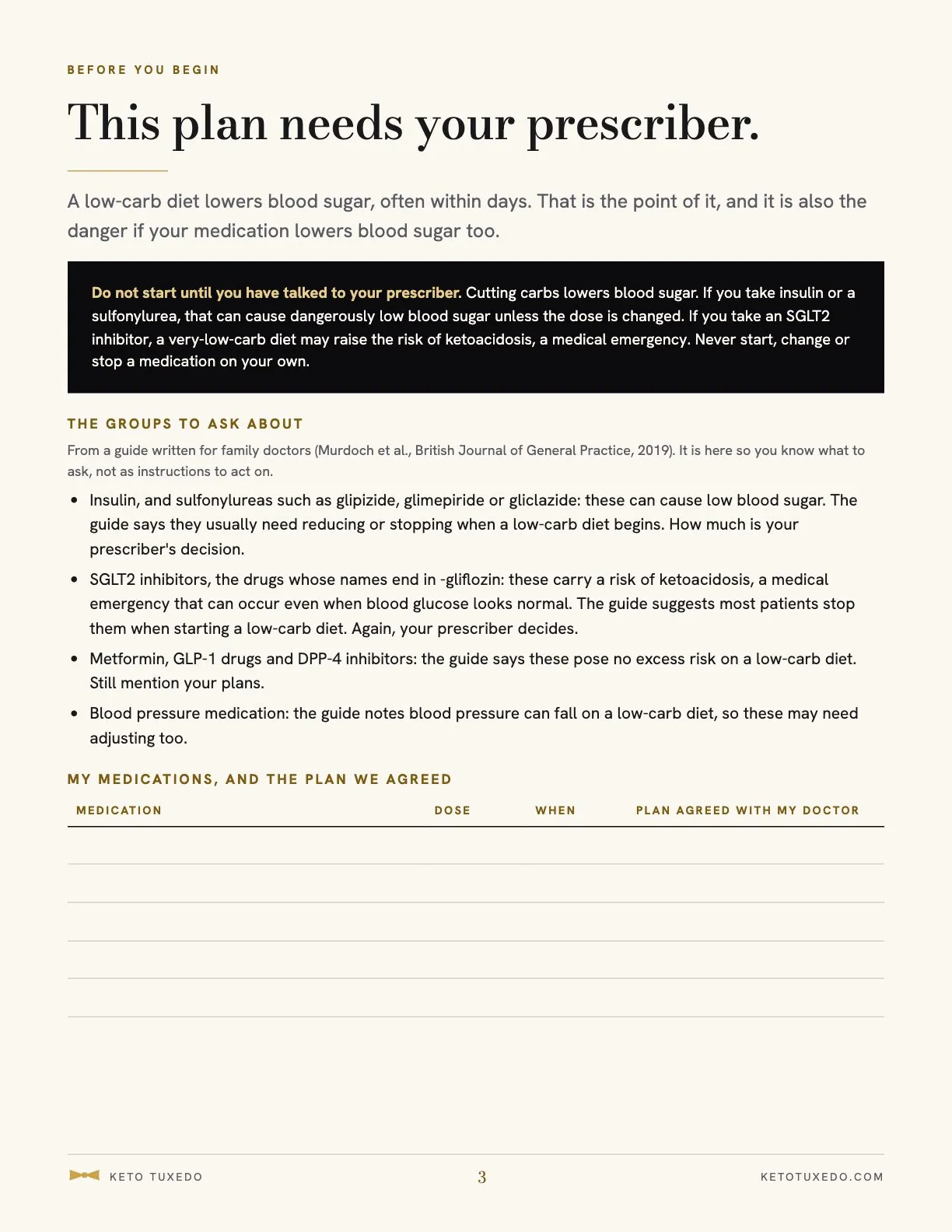
A low-carb diet lowers blood sugar. If your medication lowers it too, the two can add up to a dangerous low. A guide written for family doctors says some drugs usually need reducing or stopping when carbs are cut. That is your prescriber’s call, and it comes before the first meal.
Ask your prescriber about
- Insulin, and sulfonylureas such as glipizide, glimepiride or gliclazide: these can cause low blood sugar. The guide says they usually need reducing or stopping when a low-carb diet begins. How much is your prescriber's decision.
- SGLT2 inhibitors, the drugs whose names end in -gliflozin: these carry a risk of ketoacidosis, a medical emergency that can occur even when blood glucose looks normal. The guide suggests most patients stop them when starting a low-carb diet. Again, your prescriber decides.
- Metformin, GLP-1 drugs and DPP-4 inhibitors: the guide says these pose no excess risk on a low-carb diet. Still mention your plans.
A summary so you know what to ask, not instructions to act on. The full medication page.
Do not use this on your own if…
- You have type 1 diabetes. You always need insulin, the risk of ketoacidosis is real, and the American Diabetes Association's consensus report found no qualifying trials of low-carb eating patterns in adults with type 1.
- You take an SGLT2 inhibitor (a drug ending in -gliflozin). A guide for family doctors warns of ketoacidosis that can occur with normal blood glucose.
- You take insulin or a sulfonylurea and have not yet agreed a plan with your prescriber. Why that matters.
- You were not overweight when you were diagnosed, or you have had diabetes for many years. The same guide notes you may be making too little insulin of your own, which changes what is safe.
Five things worth knowing before you change your plate
Each one links to its source and, just as plainly, to that source’s limits.
Why Men Get Type 2 Diabetes at a Lower Weight
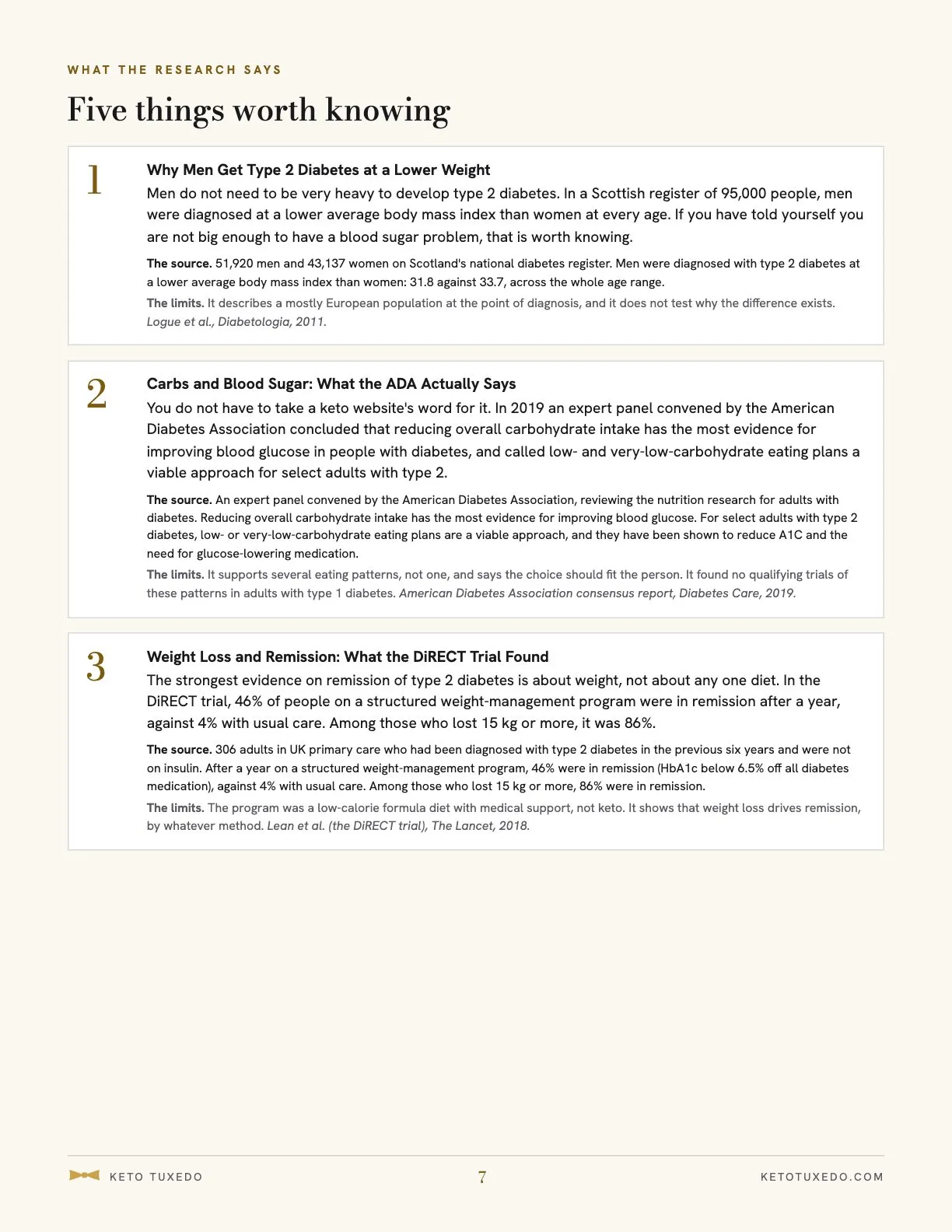
In a register of 95,000 people, men were diagnosed at a lower body mass index than women. A bit overweight can be enough.
Logue et al., Diabetologia, 2011 · read the source →
Carbs and Blood Sugar: What the ADA Actually Says
The ADA's own consensus report says cutting carbs has the most evidence for improving blood glucose.
American Diabetes Association consensus report, Diabetes Care, 2019 · read the source →
Weight Loss and Remission: What the DiRECT Trial Found
In a UK trial, 46% were in remission after a year of structured weight loss. The diet was not keto. Weight was the lever.
Lean et al. (the DiRECT trial), The Lancet, 2018 · read the source →
What Happened in the Keto Trials
One-year results were strong, with doctors adjusting medication throughout. Across 23 trials the benefit faded by month 12.
Hallberg et al., Diabetes Therapy, 2018 · read the source →
Alcohol, Insulin and the Low at 3 a.m.
Alcohol can drop your blood sugar hours later, especially on insulin or a sulfonylurea. Low-carb drinks do not change that.
American Diabetes Association consensus report (alcohol), Diabetes Care, 2019 · read the source →
Because it is dinner, not a diet.
The American Diabetes Association’s consensus report says reducing carbohydrate has the most evidence for improving blood glucose, and calls low- and very-low-carb eating plans a viable approach for select adults with type 2.
The catch is in the longer trials. Across 23 randomized studies, low-carb diets were clearly ahead at six months and roughly level by twelve. The diets did not stop working. People stopped following them.
So the menu matters more than the theory. Ribeye with creamed spinach. Chicken in a garlic cream sauce. Salmon with crisp skin. Food a man would order anyway, with the starch taken away and the carbs counted for him.
What we will not tell you
- That keto reverses or cures diabetes. Doctors say remission, and it is driven mainly by weight loss, by any method.
- That you will come off your medication. That is your prescriber’s decision, based on your readings.
- That it is safe to start without your doctor. With insulin, a sulfonylurea or an SGLT2 inhibitor, it is not.
- That it suits type 1 diabetes. It was not written for it.
- That customers rave about it. This is a new product, and reviews will appear here only when real ones exist.
Built to be used with your doctor.
The Long Game is a two-week keto plan for men with type 2 diabetes who would rather eat steak than count exchanges. It starts with the conversation to have with your doctor and the medications to ask about, then gives you 14 days of menus with total carbs, net carbs and protein for every meal, two shopping lists, 36 recipes and a log for your readings. It is a cookbook and a plan to use alongside your medical care. It is not a treatment, and it does not replace your doctor or your medication.
The doctor-first section
Which medications to ask about before you start, the questions to take to the appointment, the signs of a low and what to do, and who should not do this at all.
What the research says
Five things worth knowing about men, carbs, weight and remission, each with the study behind it and that study’s limits.
14 days of menus
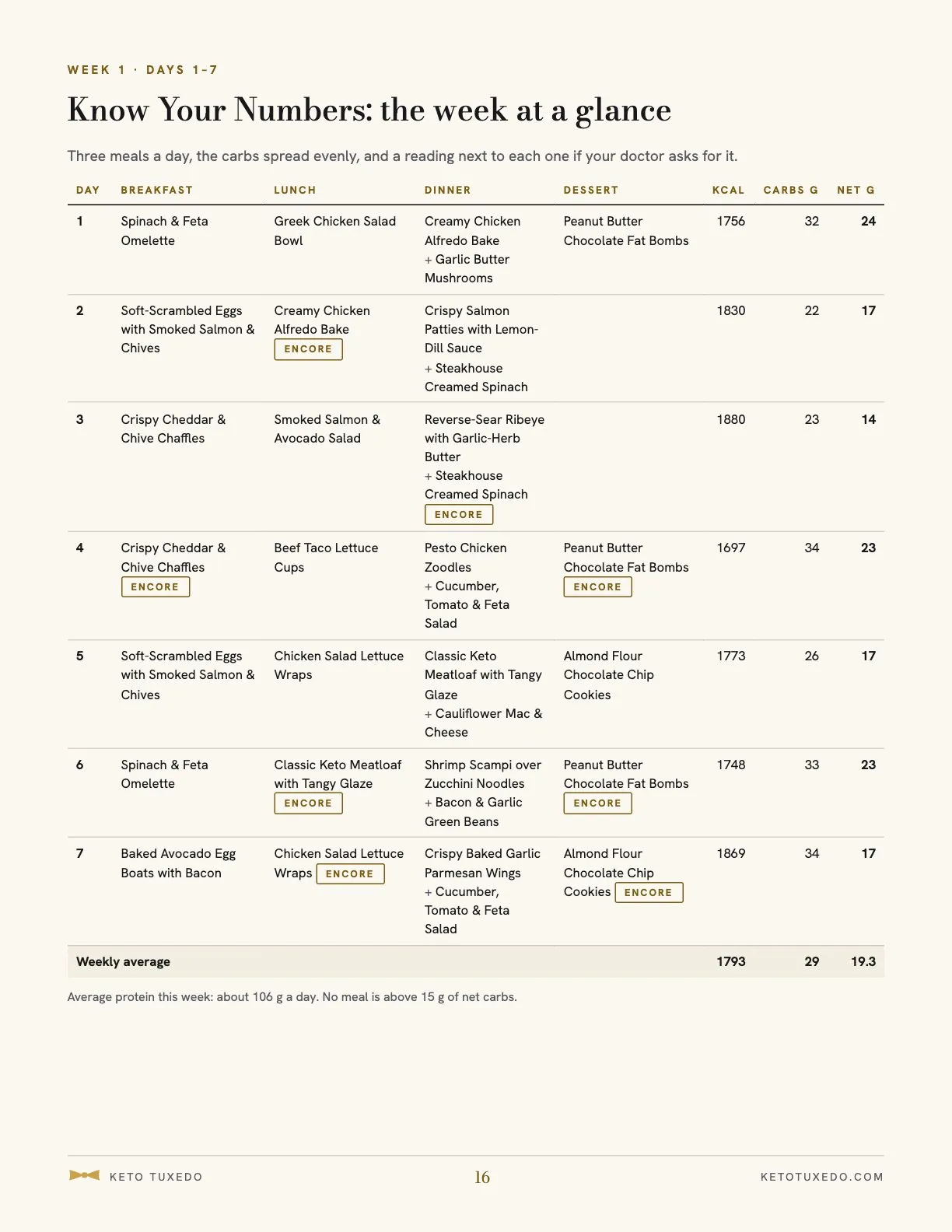
Breakfast, lunch and dinner for every day, with total carbs, net carbs, protein and calories for each meal, and no meal above 15 grams of net carbs.
36 recipes in full
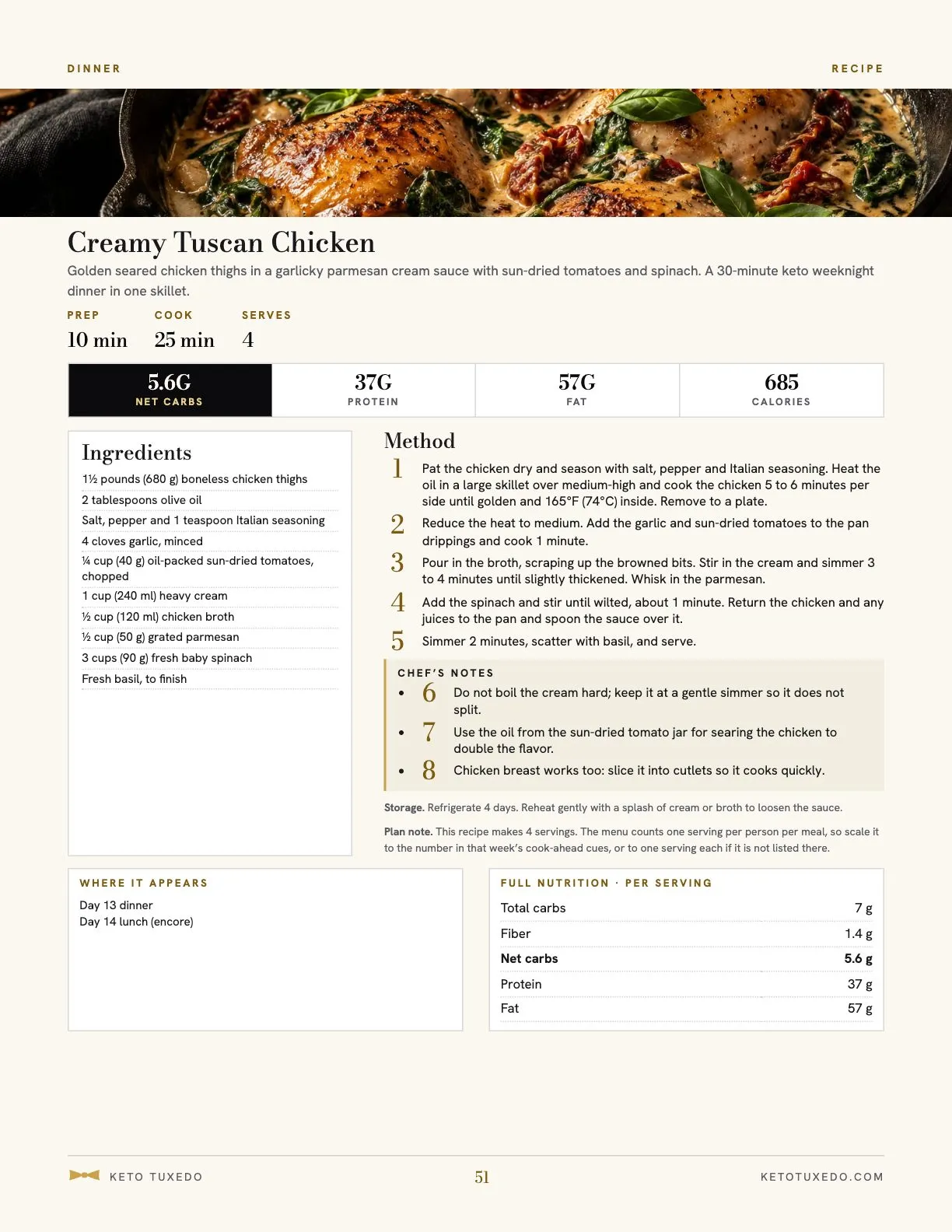
Every dish on the menu with exact ingredients, step-by-step method, tips and per-serving nutrition, including total carbs and fiber.
Two weekly shopping lists
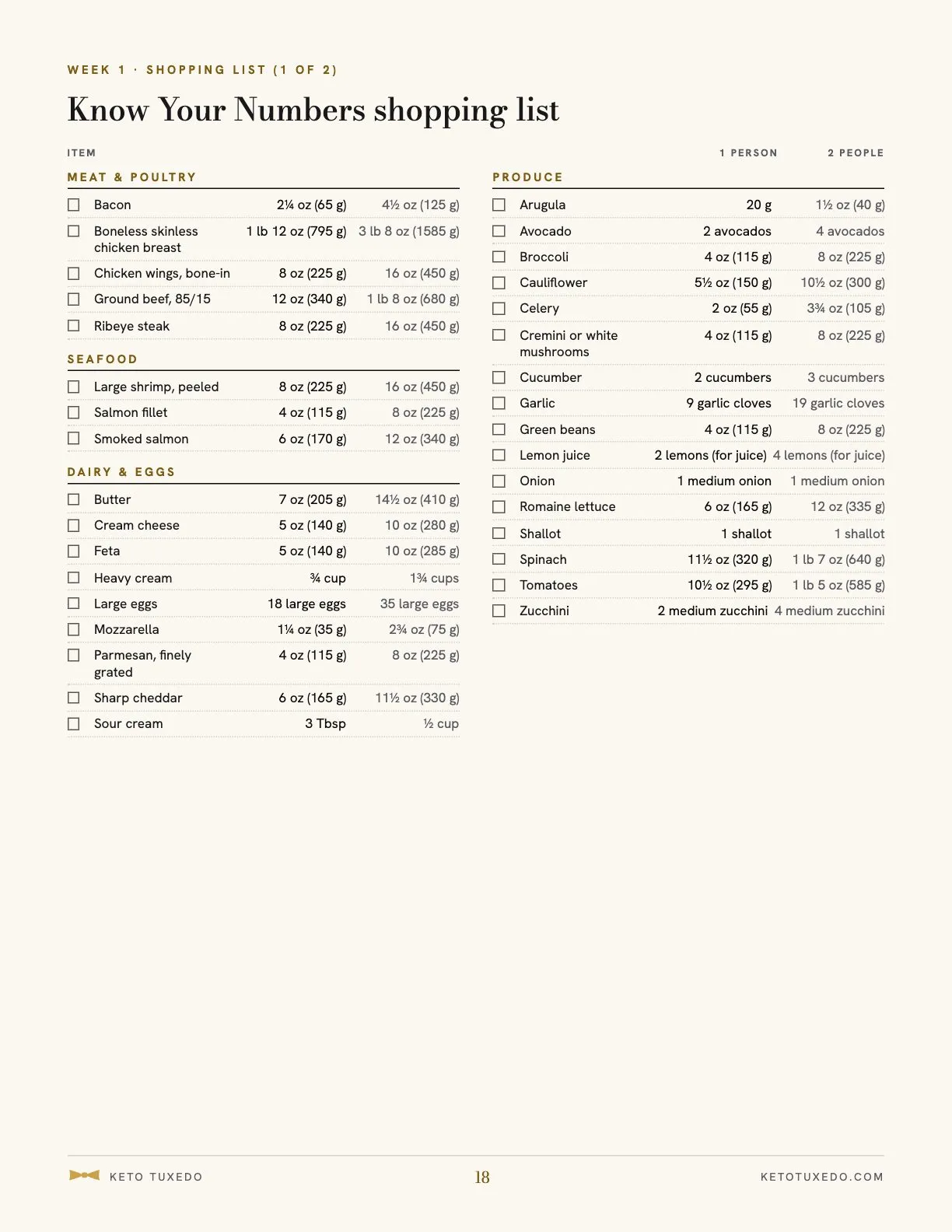
Quantities added up for you and sorted by store section, for one person and for two, plus a short prep plan for each week.
The readings log
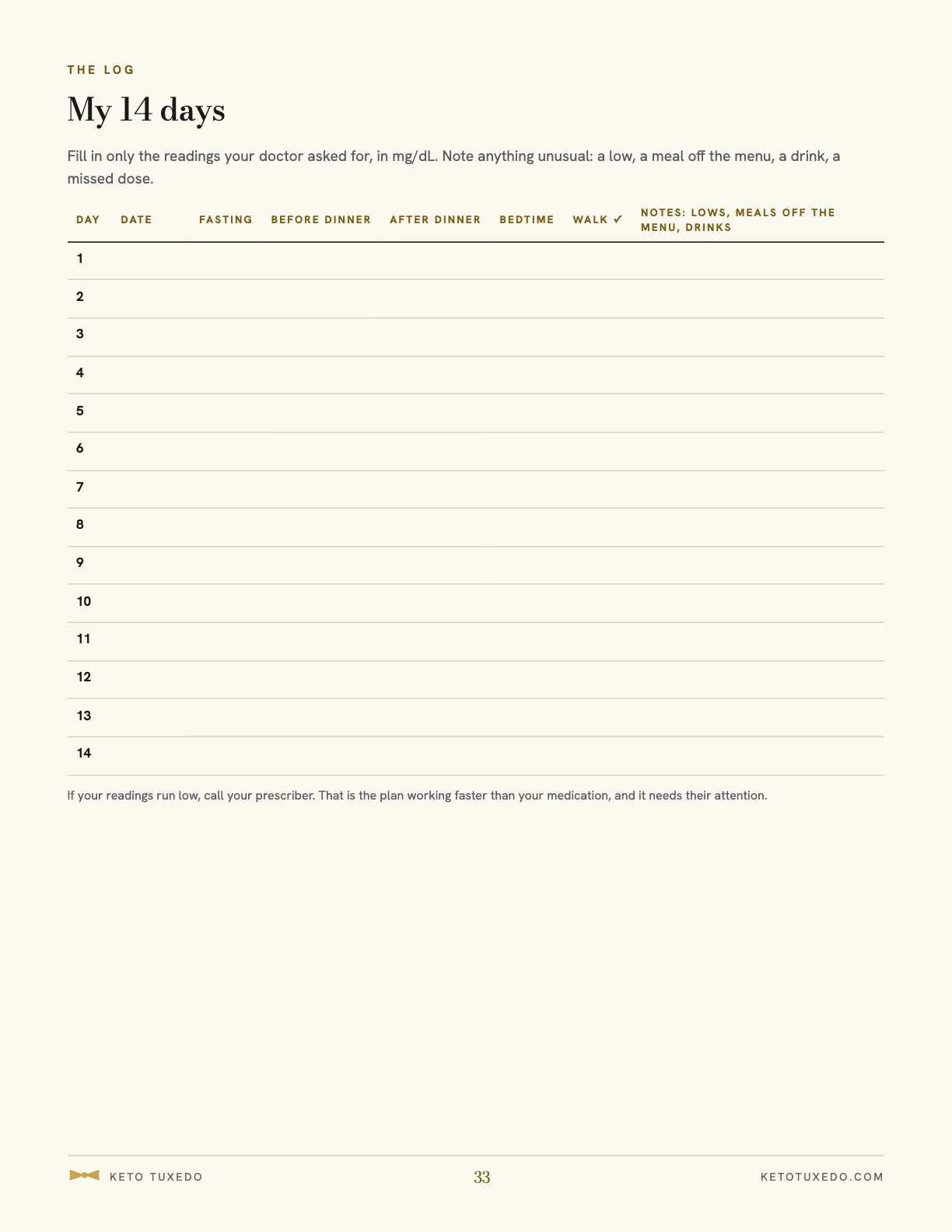
A 14-day page for glucose readings, meals and after-dinner walks, a weekly page for weight and waist, and a one-page summary for your doctor.
The bar and the label
Carb counts for the drinks men actually order, why alcohol needs extra care on medication, and when to trust total carbs over net carbs.
A peek inside
77 clean, printable pages.

Both carb numbers, on every plate.
Three real meals a day, about 1800 calories, 32 grams of total carbs and 21 grams of net carbs across the two weeks, with no meal above 15 grams of net carbs.
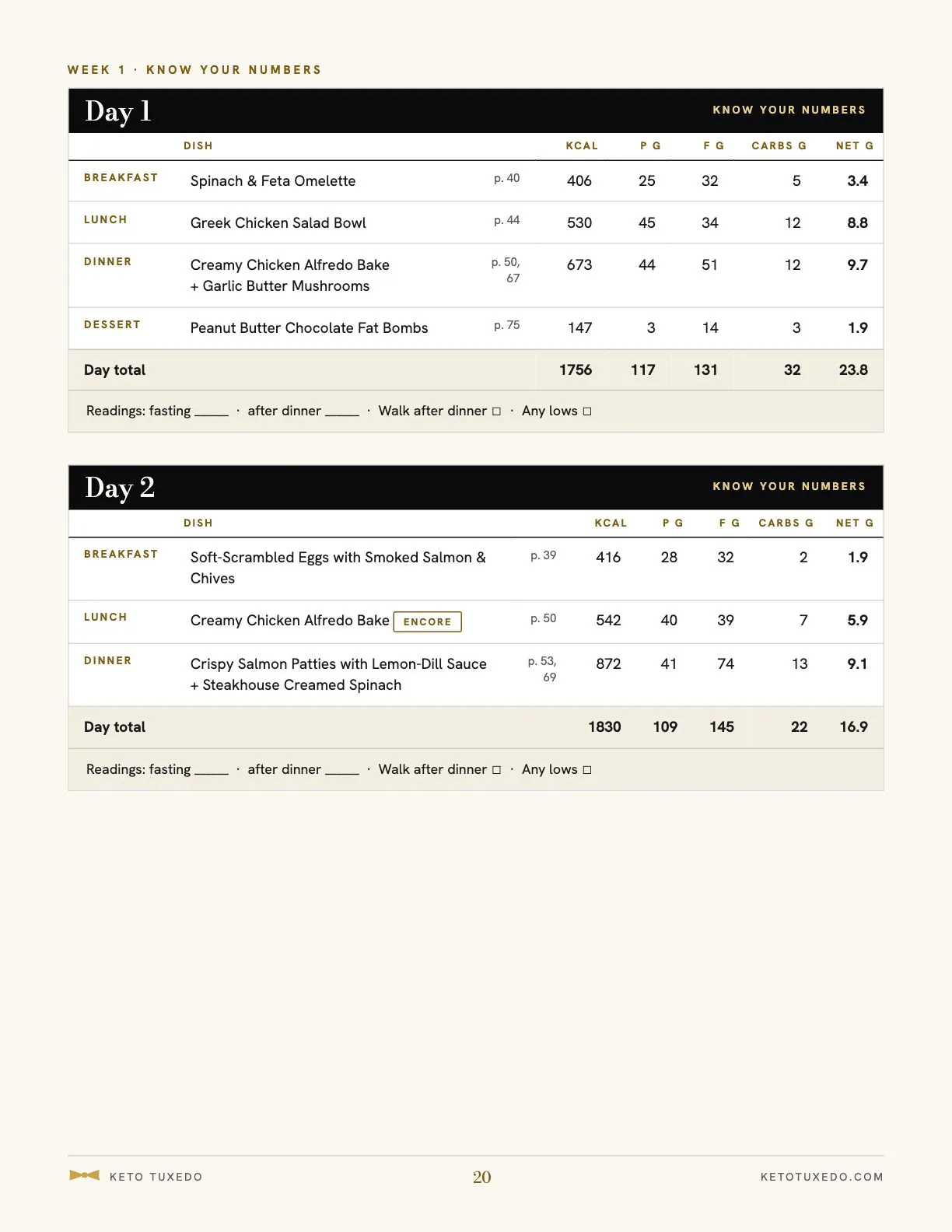
Keto counts net carbs. The American Diabetes Association does not recognize the term, so the menu shows total carbs beside it and you can use whichever your care team prefers. Everything is calculated from the ingredients in each recipe.
| Breakfast | Spinach & Feta Omelette | 5 g carbs · 3.4 g net |
|---|---|---|
| Lunch | Greek Chicken Salad Bowl | 12 g carbs · 8.8 g net |
| Dinner | Creamy Chicken Alfredo Bake | 7 g carbs · 5.9 g net |
| Side | Garlic Butter Mushrooms | 5 g carbs · 3.8 g net |
| Dessert | Peanut Butter Chocolate Fat Bombs | 3 g carbs · 1.9 g net |
| Day total | 1756 kcal · 117 g protein | 32 g carbs · 23.8 g net |
This is for you if…
- You have type 2 diabetes or prediabetes and want to try eating low-carb, properly.
- You are willing to talk to your doctor first and want to know what to ask.
- You would rather follow a written menu than count carbs at every meal.
- Or you cook for a man like that, and want one dinner the whole table can eat.
Choose your start
Instant download. 14-day satisfaction guarantee: email us for a refund if it is not for you.
The Long Game Playbook
$19
- The doctor-first section and medication checklist
- The 14-day menu, 36 recipes, two shopping lists
- The readings log and the page for your doctor
The Long Game Bundle
$39$48
- Everything in the playbook
- Plus the 28-Day Plan: four more weeks of menus and 50+ recipes ($29 on its own)
- Six weeks of dinners in one download
The Long Game is general information and a meal plan for adults with type 2 diabetes. It does not diagnose, treat or cure any condition, and results vary. Never change a medication without your prescriber.
The Doctor’s Brief: free, for your next appointment
Cutting carbs lowers blood sugar, so the first step is a conversation about your medication. This printable gives you the page to fill in, the questions to ask and a 14-day log to bring back.
Straight answers
Will this lower my blood sugar or get me off medication?
We cannot promise either, and nobody should. Research shows low-carb eating lowers blood glucose for many people with type 2 diabetes, which is exactly why your medication may need to change before you start. Whether any medication is reduced is your prescriber’s decision, based on your readings.
I take insulin or a sulfonylurea. Can I use this?
Only with your prescriber involved from the start. Cutting carbs while on these drugs can cause dangerously low blood sugar. The playbook opens with the questions to ask. Do not begin the menu until you have agreed a plan.
I take an SGLT2 inhibitor (a drug ending in -gliflozin). Can I use this?
Not without your doctor’s explicit go-ahead. These drugs carry a risk of ketoacidosis, and a guide for family doctors suggests most patients stop them before starting a low-carb diet. That is a decision for your prescriber.
Is this for type 1 diabetes?
No. It was written for type 2. If you have type 1, changing your diet without your diabetes team can be dangerous.
Do you count total carbs or net carbs?
Both are shown for every meal. Keto counts net carbs, but the American Diabetes Association does not recognize the term, so you can use whichever number your care team prefers.
Are the recipes exclusive to this book?
No. The menu is built from our free recipe collection, arranged into 14 days with shopping lists, prep plans and the log. You are paying for the plan and the playbook. For four more weeks of menus and 50+ recipes, add the 28-Day Plan in the Long Game Bundle.
How many calories and carbs is the menu?
Each day averages about 1800 calories, 106 grams of protein, 32 grams of total carbs and 21 grams of net carbs. A scaling chart shows how to move that up or down. These are estimates, not medical advice.
How do I receive it?
Immediately after checkout you get a download link by email and on the confirmation page. It is a PDF that works on any phone, tablet or computer and prints cleanly.
What if I do not love it?
You are covered by our satisfaction guarantee: email us within 14 days of purchase and we will refund you, no hoops.
Step one is a phone call.
Book the appointment. Take your medication list and six questions. Then cook a proper dinner, write down your readings, and see what two weeks tells you and your doctor.
Not medical advice. Written for adults with type 2 diabetes. Do not start a very-low-carb diet, or change any medication, without your prescriber. See our health disclaimer.